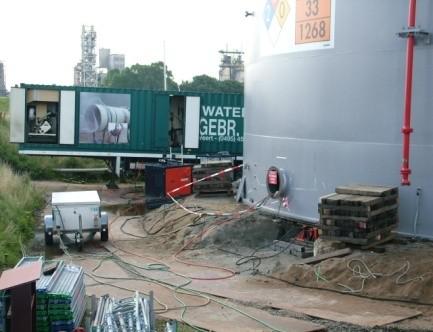
Shell Exploration and Production – Tank Internal Coating Removal, Delfzijl

Project Overview

Shell Exploration and Production’s Delfzijl tank park facility in the Netherlands operates a significant number of storage tanks that require periodic maintenance, including the removal and replacement of internal coating systems to maintain structural integrity, prevent corrosion, and meet ongoing operational and safety standards. Each tank holds approximately 215m2 of internal coating surface that must be stripped as part of routine upkeep.

Conventional methods used at the facility had historically relied on dry abrasive blasting with sand or ultra-high pressure (UHP) water jetting. Sand blasting costs approximately 35 euros per m2 stripped and generates 83.80 euros per tonne in abrasive disposal costs, with the volumes of spent sand from a 215m2 tank creating substantial waste handling, transport, and disposal burdens that add both time and cost to every maintenance cycle. UHP water jetting, while reducing abrasive waste, introduces its own complications, costing around 30 euros per m2 stripped and requiring high-pressure tools that pose safety risks to operators working in confined tank environments. With two teams working simultaneously, UHP water jetting still takes approximately two and a half weeks to complete the internal stripping of a single tank.

Both methods expose operators to elevated health and safety risks, requiring specialised protective clothing and respiratory equipment. The dust generated by dry blasting and the high-pressure water and debris from UHP jetting create hazardous working conditions demanding extensive personal protective equipment and careful site management. Shell’s evaluation sought a method that could address all of these shortcomings simultaneously, delivering faster turnaround, lower waste volumes, reduced operator risk, and a lower overall cost per m2 treated. RPR Induction technology was identified as a strong candidate and brought in for formal evaluation at the Delfzijl facility.

Services Included

RPR Technologies delivered a comprehensive induction-based coating removal service across Shell’s Delfzijl tank park facility, covering the full scope of internal coating stripping requirements for the storage tank maintenance programme.

The RPR induction system is capable of removing a wide range of coating types, including fireproof paints, solvent-free epoxy systems, thick and difficult-to-remove coatings, glued or vulcanised rubber linings, and powder coatings. This versatility made it well suited to the varied coating systems present across the Delfzijl storage tanks.

Services delivered included full internal coating removal across 215m2 per tank, with zero kilograms of abrasive waste generated throughout the process. The induction system produced no dust and no noise nuisance, significantly improving working conditions for operators inside confined tank environments. No special respiratory equipment or high-pressure tools were required, reducing the personal protective equipment burden and making the working environment considerably safer and more manageable.

The practical throughput of the RPR system scales directly with the power output of the unit deployed. At 10kW, the system treats 20 lineal meters (at Inductor head width) per hour; at 25kW, this increases to 40 lineal meters per hour; and at 50kW the system achieves 70 lineal meters per hour across the same coating type. For the 215m2 internal surface area of a Delfzijl tank, RPR estimated a total project duration of approximately one week per tank, compared to two and a half weeks for UHP water jetting even with two teams working simultaneously.

A key operational advantage was the ability to carry out tank inspection and repair work simultaneously with the coating removal process. Because RPR does not require the same degree of exclusion zone management that abrasive blasting and UHP water jetting demand, parallel working was possible, directly reducing total downtime per maintenance cycle and improving asset availability across the facility.


Conclusion

The RPR induction system delivered on every key measure evaluated by Shell Exploration and Production at the Delfzijl facility. On cost, RPR came in at between 25 and 35 euros per m2 stripped, equal to or better than UHP water jetting and competitive with sand blasting, while generating zero abrasive waste and eliminating high-pressure tooling from the confined tank environment entirely.

On speed, the estimated project duration dropped from two and a half weeks with UHP water jetting to approximately one week per tank using RPR, a significant reduction that directly improves the availability of storage assets across the facility. The ability to run tank inspection and repair work simultaneously with coating removal, something not possible with abrasive blasting or UHP methods, further compresses total maintenance downtime and delivers additional operational value beyond the coating removal itself.

On safety, the RPR process created a dramatically improved working environment for operators. With no dust, no noise nuisance, no abrasive waste, and no requirement for high-pressure tools or specialised respiratory equipment, the risk profile for confined space work was substantially reduced compared to conventional methods. Operators needed only standard protective clothing, making the site safer and easier to manage throughout the project.

Shell’s evaluation at Delfzijl demonstrates the broader potential of RPR induction technology to transform routine tank maintenance programmes across industrial facilities. For any operation managing large numbers of storage tanks with periodic coating removal requirements, RPR offers a compelling combination of speed, cost competitiveness, safety improvement, and waste reduction that conventional methods simply cannot match.

Project Overview

2026

Shell Exploration and Production’s Delfzijl tank park facility in the Netherlands operates a significant number of storage tanks that require periodic maintenance, including the removal and replacement of internal coating systems to maintain structural integrity, prevent corrosion, and meet ongoing operational and safety standards. Each tank holds approximately 215m2 of internal coating surface that must be stripped as part of routine upkeep.

Conventional methods used at the facility had historically relied on dry abrasive blasting with sand or ultra-high pressure (UHP) water jetting. Sand blasting costs approximately 35 euros per m2 stripped and generates 83.80 euros per tonne in abrasive disposal costs, with the volumes of spent sand from a 215m2 tank creating substantial waste handling, transport, and disposal burdens that add both time and cost to every maintenance cycle. UHP water jetting, while reducing abrasive waste, introduces its own complications, costing around 30 euros per m2 stripped and requiring high-pressure tools that pose safety risks to operators working in confined tank environments. With two teams working simultaneously, UHP water jetting still takes approximately two and a half weeks to complete the internal stripping of a single tank.

Both methods expose operators to elevated health and safety risks, requiring specialised protective clothing and respiratory equipment. The dust generated by dry blasting and the high-pressure water and debris from UHP jetting create hazardous working conditions demanding extensive personal protective equipment and careful site management. Shell’s evaluation sought a method that could address all of these shortcomings simultaneously, delivering faster turnaround, lower waste volumes, reduced operator risk, and a lower overall cost per m2 treated. RPR Induction technology was identified as a strong candidate and brought in for formal evaluation at the Delfzijl facility.

Services Included

RPR Technologies delivered a comprehensive induction-based coating removal service across Shell’s Delfzijl tank park facility, covering the full scope of internal coating stripping requirements for the storage tank maintenance programme.

The RPR induction system is capable of removing a wide range of coating types, including fireproof paints, solvent-free epoxy systems, thick and difficult-to-remove coatings, glued or vulcanised rubber linings, and powder coatings. This versatility made it well suited to the varied coating systems present across the Delfzijl storage tanks.

Services delivered included full internal coating removal across 215m2 per tank, with zero kilograms of abrasive waste generated throughout the process. The induction system produced no dust and no noise nuisance, significantly improving working conditions for operators inside confined tank environments. No special respiratory equipment or high-pressure tools were required, reducing the personal protective equipment burden and making the working environment considerably safer and more manageable.

The practical throughput of the RPR system scales directly with the power output of the unit deployed. At 10kW, the system treats 20 lineal meters (at Inductor head width) per hour; at 25kW, this increases to 40 lineal meters per hour; and at 50kW the system achieves 70 lineal meters per hour across the same coating type. For the 215m2 internal surface area of a Delfzijl tank, RPR estimated a total project duration of approximately one week per tank, compared to two and a half weeks for UHP water jetting even with two teams working simultaneously.

A key operational advantage was the ability to carry out tank inspection and repair work simultaneously with the coating removal process. Because RPR does not require the same degree of exclusion zone management that abrasive blasting and UHP water jetting demand, parallel working was possible, directly reducing total downtime per maintenance cycle and improving asset availability across the facility.


Conclusion

The RPR induction system delivered on every key measure evaluated by Shell Exploration and Production at the Delfzijl facility. On cost, RPR came in at between 25 and 35 euros per m2 stripped, equal to or better than UHP water jetting and competitive with sand blasting, while generating zero abrasive waste and eliminating high-pressure tooling from the confined tank environment entirely.

On speed, the estimated project duration dropped from two and a half weeks with UHP water jetting to approximately one week per tank using RPR, a significant reduction that directly improves the availability of storage assets across the facility. The ability to run tank inspection and repair work simultaneously with coating removal, something not possible with abrasive blasting or UHP methods, further compresses total maintenance downtime and delivers additional operational value beyond the coating removal itself.

On safety, the RPR process created a dramatically improved working environment for operators. With no dust, no noise nuisance, no abrasive waste, and no requirement for high-pressure tools or specialised respiratory equipment, the risk profile for confined space work was substantially reduced compared to conventional methods. Operators needed only standard protective clothing, making the site safer and easier to manage throughout the project.

Shell’s evaluation at Delfzijl demonstrates the broader potential of RPR induction technology to transform routine tank maintenance programmes across industrial facilities. For any operation managing large numbers of storage tanks with periodic coating removal requirements, RPR offers a compelling combination of speed, cost competitiveness, safety improvement, and waste reduction that conventional methods simply cannot match.

Share:

Explore innovation, technology and news from our journey

Explore the latest innovations, project stories, and insights from the ACR Tech team.