

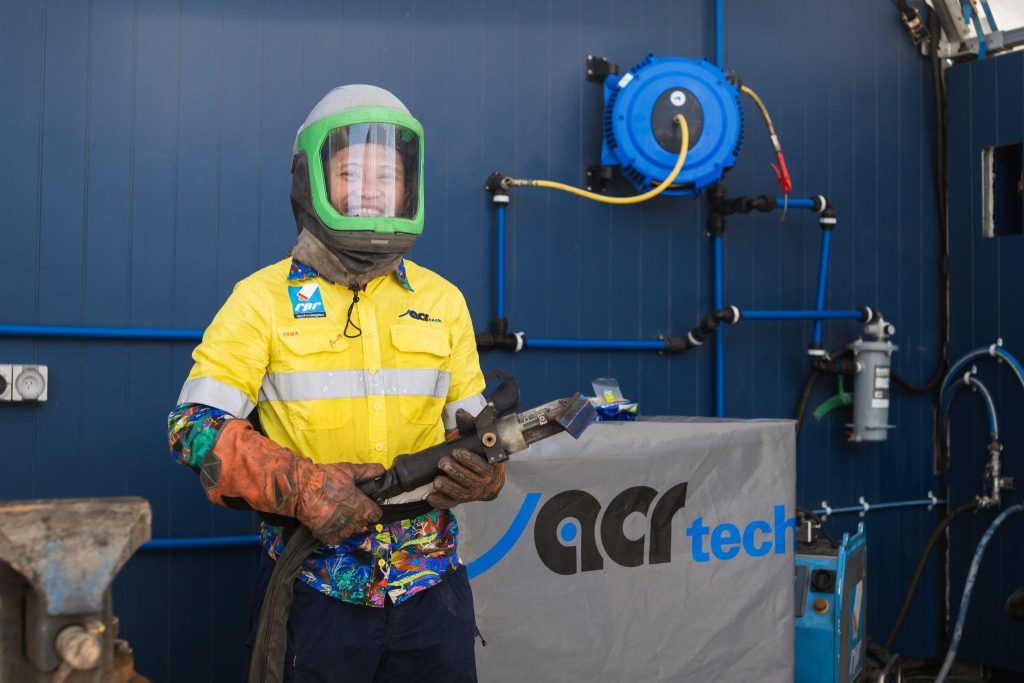
Planning a Lead Paint Removal Project in Australia: Compliance, Licensing and Site Setup[a]
Lead-based paint remains one of the most persistent legacy hazards on Australian industrial infrastructure. From bridges and marine structures built before the 1970s to tanks, storage vessels and heavy plant, lead paint coatings continue to pose serious health and environmental risks when disturbed. Planning a lead paint removal project in Australia is not simply a matter of selecting a removal method — it requires a structured approach to compliance, licensing, worker protection and site containment before a single tool touches the surface.
This guide outlines the key regulatory, licensing and operational considerations for any organisation planning a lead paint removal project, and explains how modern coating removal technologies are changing the way hazardous coatings are managed on Australian industrial assets.
Understanding the Risk Profile of Lead-Based Coatings
Lead was widely used in protective and decorative coatings across Australian infrastructure until well into the 1990s, particularly on steel bridges, marine structures, storage tanks, rail assets and mining infrastructure. When these coatings are disturbed through grinding, blasting or uncontrolled mechanical removal, lead-contaminated dust and particulate can become airborne, settle on surrounding surfaces, and create long-term exposure risks for workers, contractors and nearby communities.
Under Australian Work Health and Safety (WHS) regulations, lead is classified as a hazardous substance with strict exposure standards. Any project involving the removal, disturbance or demolition of lead-painted surfaces is treated as high-risk work, requiring a documented risk assessment, exposure controls and, in many cases, specific licensing before work commences.
The Regulatory Framework Governing Lead Paint Removal
Lead paint removal projects in Australia sit within a layered regulatory framework:
- Work Health and Safety Act and Regulations (state-based, harmonised nationally) — establish the primary duty of care for PCBUs (Persons Conducting a Business or Undertaking) to eliminate or minimise exposure to lead.
- Safe Work Australia Code of Practice: Managing the Risks of Lead in the Workplace — provides detailed guidance on air monitoring, blood lead level testing, exposure standards and control hierarchies.
- National Environment Protection Measures and state EPA guidelines — govern the containment, capture and disposal of lead-contaminated waste and runoff, particularly for marine, tank and bridge projects near waterways.
- AS/NZS 4576 and related scaffolding, containment and access standards — relevant where enclosures, shrouding or elevated work platforms are used during removal.
Because lead exposure standards are enforced at both a workplace and environmental level, projects often require sign-off from more than one regulatory body, particularly when work is near waterways, residential areas or heritage-listed structures such as bridges.
Licensing and Competency Requirements
Unlike asbestos removal, lead paint removal does not require a single national licence category. However, several licensing and competency requirements typically apply:
- Lead-related work training — workers must be trained in the specific hazards of lead exposure, correct use of respiratory protective equipment (RPE), and decontamination procedures.
- Blood lead level monitoring — many state regulators require baseline and periodic blood lead testing for workers engaged in lead removal activities, with mandatory removal from lead work if thresholds are exceeded.
- Air monitoring competency — occupational hygienists or trained personnel must conduct exposure monitoring in accordance with the relevant WHS regulation.
- Environmental discharge approvals — where work occurs over water or near stormwater systems (common on bridges, marine infrastructure and tanks), a permit or approval from the relevant environmental authority is often required before containment and capture systems are approved for use.
- High-risk work licences — where associated activities such as scaffolding, EWP operation or confined space entry are involved, standard state-issued high-risk work licences apply in addition to lead-specific competencies.
Engaging a contractor with demonstrated experience across these requirements significantly reduces project risk. ACR Tech works closely with clients across the mining and resources, marine infrastructure, bridges and tanks and bulk storage sectors to ensure hazardous coating projects are planned against the correct regulatory pathway from the outset.
Site Setup: Containment, Access and Exposure Control
Effective site setup is the foundation of a compliant lead paint removal project. Regardless of the removal method chosen, the following elements are typically required:
1. Risk assessment and safe work method statement (SWMS)
A documented SWMS specific to lead removal must identify exposure pathways, control measures, PPE requirements and emergency procedures.
2. Physical containment
Enclosures, shrouding or negative-pressure systems are used to prevent lead dust and debris from migrating beyond the work area. For bridges and marine structures, containment must also account for wind, tidal movement and proximity to water.
3. Waste capture and segregation
All coating residue, dust and spent media must be captured at source wherever possible and segregated as hazardous waste, in line with state EPA requirements.
4. Decontamination facilities
Personnel decontamination units, wash-down stations and controlled entry/exit points are required to prevent cross-contamination of clean zones.
5. Air monitoring and exposure verification
Ongoing monitoring confirms that exposure levels remain within regulatory limits throughout the works, with results documented for compliance reporting.
6. Waste transport and disposal documentation
Lead-contaminated waste must be tracked from site to licensed disposal facility, with appropriate manifests and chain-of-custody records maintained.
Site setup requirements scale significantly with the volume of coating being removed and the removal method selected — which is why method selection is one of the most important decisions in the planning phase.
Choosing a Removal Method: Why Method Selection Drives Compliance Outcomes
Traditional lead paint removal methods — abrasive blasting, ultra-high-pressure water (UHPW) blasting and chemical stripping — remain common across Australian industry. However, each generates substantial secondary waste streams. Abrasive media becomes contaminated with lead residue and must be managed as hazardous waste in its entirety, dramatically increasing disposal volumes and cost. Dust generation also raises the burden of containment, monitoring and PPE requirements on site.
Induction Coating Removal (ICR) offers a fundamentally different approach, and one that is increasingly relevant to lead paint projects across bridges, tanks, marine structures and industrial plant.
ICR uses electromagnetic induction to disbond coatings from ferromagnetic substrates. An induction generator delivers high-frequency alternating current — up to approximately 50 kHz — through a transformer and inductor head. This induces eddy currents within the top layer of the steel substrate, to a controlled depth of less than 0.5mm, generating rapid, localised heating directly beneath the induction head. As the substrate temperature rises, the bond line between the coating and the steel is weakened, allowing the coating to lift away in large, largely intact sections rather than fine particulate.
For lead paint removal specifically, this has direct compliance benefits:
- Reduced[b] dust generation — because coatings disbond in bulk sections rather than being abraded into fine dust, airborne lead particulate is significantly reduced, lowering worker exposure risk and easing air monitoring burdens.
- Lower secondary waste volumes — coating removed via ICR retains much of its physical integrity, meaning less contaminated waste requiring hazardous disposal compared to abrasive media that must be treated as contaminated in its entirety.
- Zero abrasive media and zero chemical strippers — this removes the handling, storage and disposal obligations associated with contaminated blast media or chemical stripping agents.
- Simplified containment requirements — with less airborne particulate, containment and negative-pressure systems can often be simplified, though appropriate controls remain necessary.
- Compatibility with live and sensitive assets — the ICR system used by ACR Tech, based on RPR Technologies, is approved for use on live pipelines, and its portable configuration — with the induction head operable up to approximately 90 metres from the source unit — makes it well suited to field applications such as bridges, shipyards and marine infrastructure where access and containment constraints are significant.
Where project specifications still call for a defined surface cleanliness standard prior to recoating, ICR functions as a powerful enabler — rapidly stripping the bulk of the hazardous coating and substantially reducing the abrasive blasting or final cleaning effort required afterwards, further reducing the overall hazardous waste footprint of the project.
Waste Management and Disposal Obligations
Regardless of removal method, all lead-contaminated waste generated during the project must be managed under state EPA waste classification rules. Key obligations typically include:
- Classification of waste as hazardous based on lead concentration testing
- Use of licensed hazardous waste transporters
- Disposal at facilities licensed to accept lead-contaminated material
- Retention of waste tracking documentation for audit and compliance purposes
Because ICR reduces the total volume of waste requiring hazardous classification, projects can see meaningful reductions in disposal cost and administrative burden — a factor increasingly considered in tender evaluations for large-scale infrastructure maintenance.
Building a Compliance Checklist Before Mobilisation
Before mobilising to site, project owners and contractors should confirm:
- Risk assessment and SWMS specific to lead exposure are finalised and approved
- Worker training, competency records and baseline blood lead testing are current
- Containment and decontamination systems are designed for the specific asset and environment
- Environmental approvals are secured where work occurs near water or sensitive receptors
- Waste transport and disposal arrangements are confirmed with licensed providers
- Air monitoring protocols are scheduled throughout the works
- The selected removal method aligns with both the coating type and the site's exposure and waste reduction objectives
Partnering with an Experienced Hazardous Coatings Contractor
Lead paint removal projects carry regulatory, safety and environmental obligations that extend well beyond the physical act of coating removal. Getting the planning, licensing and site setup right from the outset protects workers, reduces project risk, and keeps infrastructure maintenance programs on schedule.
ACR Tech specialises in hazardous coating removal across Australia's mining, marine, bridge, tank and industrial sectors, applying precision Induction Coating Removal technology to reduce dust, waste and worker exposure without compromising on program timelines. To understand how ICR can be applied to your next lead paint removal project, explore our full range of services, learn more about our team and technology partnership with RPR Technologies, or contact us to discuss your project's compliance and site setup requirements with our team.
[a]general comment. i think merge both hazardous blogs and remove duplication. a couple more photos needed showing bridges etc. asbestos pipe. we can finalise images once blog revised
[b]canb we merge the benefits here into the other hazardous coating blog. i feel there is too much duplication. just one blog for hazardous.


