

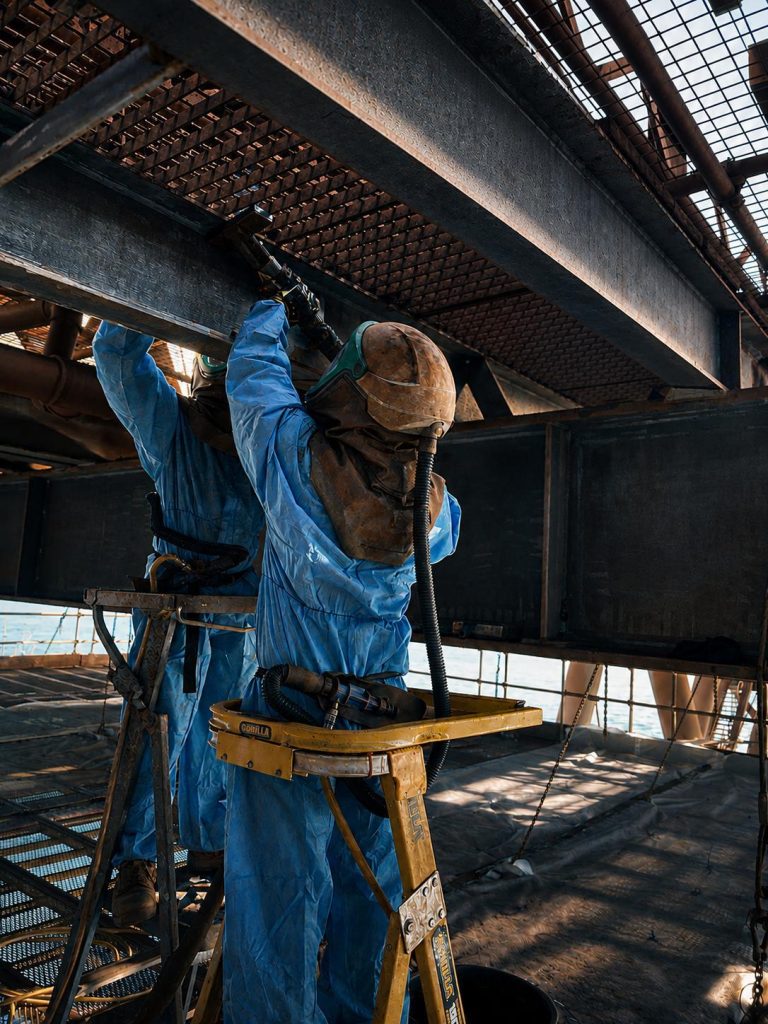
Hazardous Coating Removal Costs: Why Waste Volume Drives the Budget
When budgeting for a hazardous coating removal project, most asset owners focus on labour rates, equipment hire, and project duration. These are all valid line items, but[c] they rarely represent the largest cost driver on the job. In reality, the single biggest factor influencing the final invoice for lead paint, asbestos-containing material, or other hazardous coating removal is waste volume[d].
Every kilogram of contaminated waste generated on site must be contained, transported, treated, and disposed of in accordance with strict environmental and occupational health regulations. For hazardous coatings, this isn't a minor administrative cost — it's often the single largest expense category on the project, sometimes exceeding the cost of labour and equipment combined. Understanding why waste volume matters so much, and how modern removal technology can dramatically reduce it, is essential for any organisation planning a coating removal program across mining, marine, energy, or infrastructure assets.
Why Hazardous Waste Disposal Costs So Much
Hazardous coating waste isn't like ordinary construction debris. Lead-based paints, asbestos-containing materials, and certain rubber or chemical linings are classified as regulated hazardous waste in almost every Australian jurisdiction. This classification triggers a cascade of costs that don't apply to standard industrial waste[e]:
- Specialised transport – hazardous waste must be moved by licensed carriers using compliant vehicles and documentation (tracking manifests, chain-of-custody records).
- Licensed disposal facilities – far fewer facilities are approved to accept hazardous waste, meaning higher gate fees and often longer haul distances.
- Handling and packaging – contaminated material must be double-bagged, drummed, or otherwise contained to prevent fibre or particulate release during transit.
- Testing and certification – waste streams frequently require laboratory analysis to confirm contamination levels before a disposal facility will accept them.
- Regulatory reporting – tracking, reporting, and auditing obligations add administrative overhead that scales directly with tonnage.
Because these costs are charged per tonne or per cubic metre, the relationship between waste volume and total project cost is almost linear. Reduce the volume of contaminated waste, and every one of these downstream costs falls proportionally.
How Conventional Removal Methods Inflate Waste Volume
The problem with many traditional coating removal methods — abrasive blasting, ultra-high-pressure water (UHPW) jetting, and chemical stripping — is that they don't just remove the coating. They generate substantial volumes of secondary waste that must also be treated as hazardous.
Abrasive blasting consumes large quantities of media (garnet, slag, or steel grit) that becomes contaminated on contact with the coating and must be disposed of alongside it. A[f] job that removes a relatively thin coating layer can produce many multiples of that volume in spent abrasive. UHPW methods create hazardous slurry that requires filtration, dewatering, and separate handling before disposal. Chemical stripping introduces its own contaminated residues, along with the handling and disposal burden of the stripping agents themselves.
In every case, the original hazardous coating — often just a few millimetres thick — ends up mixed with a much larger mass of spent media, water, or chemical residue. The entire mixture must then be managed and disposed of as hazardous waste in its entirety, dramatically inflating the tonnage that drives disposal costs.
Induction Coating Removal: A Different Waste Profile
Induction Coating Removal (ICR) technology takes a fundamentally different approach, and it's this difference that produces such a favourable waste and cost outcome for hazardous coating projects.
ICR uses electromagnetic induction to disbond coatings from ferromagnetic substrates. An induction generator delivers alternating current at high frequencies — up[g][h] to approximately 50 kHz — through a transformer and inductor head. This induces eddy currents within the steel substrate to a controlled depth of less than 0.5mm[i], generating rapid, localised heating directly beneath the induction head. As the substrate temperature rises, the bond line between the coating and the steel weakens, allowing the coating to disbond and lift away in large, largely intact sections.
This mechanism has a direct and measurable impact on waste volume. Because ICR targets only the coating-to-substrate interface, no abrasive media is introduced, no water slurry is generated, and no chemical residue is left behind. The coating comes away as bulk material — sheets and sections rather than fine particulate — with its physical integrity largely preserved. There is no secondary waste stream to mix with the primary hazardous material.
The practical effect is that the total mass of hazardous waste requiring disposal is close to the actual mass of the coating itself, rather than a multiple of it inflated by spent media or contaminated water. For a project removing hazardous lead-based paint or asbestos-containing rubber linings, this can mean disposal volumes are a fraction of what conventional methods would produce for the same surface area.
The Compounding Cost Benefits of Lower Waste Volume
Reducing waste volume doesn't just save on disposal gate fees — it compounds across nearly every cost category in a hazardous coating removal project:
- Transport costs fall because fewer truckloads or containers are needed to move waste off site.
- Testing and certification costs fall because there are fewer waste streams and smaller batches to characterise.
- Labour costs fall because there is less material to bag, drum, load, and track.
- Compliance overheads fall because minimising dust generation and secondary waste reduces the complexity of health and safety management, and lowers worker exposure risk to hazardous particulate.
- Site duration falls because handling and clearing bulk-section coating waste is faster than managing fine particulate or slurry across the full project footprint.
This is also where ICR's other characteristics reinforce the cost advantage. Because the process generates zero dust and operates without abrasive blast media, sites can often maintain simpler containment and ventilation controls than would be required for open abrasive blasting of hazardous coatings. Lower energy consumption and quieter operation further reduce the operational footprint, particularly relevant on live or occupied sites such as marine infrastructure, bridges, tanks, and energy facilities where downtime and disruption carry their own costs.
Where ICR Fits in a Hazardous Coating Removal Strategy
ICR is particularly well suited to hazardous coatings such as lead-based paints, asbestos-containing materials, and rubber linings[j] — precisely the coating types where waste classification and disposal costs are most punishing. It is also compatible with a wide range of other bonded coatings, each with its own characteristic disbonding temperature, making it a versatile tool across mining and resources, marine infrastructure, bridges, tanks and bulk storage, and energy and utilities assets.
Where project specifications still call for conventional surface cleanliness standards ahead of recoating, ICR functions as a highly effective enabler rather than a complete replacement for other methods. By rapidly removing the bulk of the hazardous coating first, it significantly reduces the volume of material that needs to be addressed by final blasting or cleaning steps — shrinking the hazardous waste footprint of the entire project, not just the ICR phase.
The portability of a typical ICR configuration also matters for cost planning. With[k] the induction head operable up to approximately 90 metres from the source unit, ICR is well suited to field applications including bridges, shipyards, oil and gas facilities, and large marine and infrastructure assets — environments where mobilising large-scale containment or waste handling equipment can be logistically expensive.
Planning Your Hazardous Coating Removal Budget
For asset owners and project managers scoping a hazardous coating removal program, the key takeaway is this: don't just budget for the coating you can see. Budget for the waste stream your chosen removal method will generate. A method that appears cheaper on a per-square-metre labour basis can end up far more expensive overall once inflated waste volumes are factored into disposal, transport, and compliance costs.
Evaluating removal technologies on total waste-adjusted cost — rather than surface preparation cost alone — gives a much more accurate picture of the true budget required, and often reveals that induction-based methods deliver a lower total cost of ownership for hazardous coating projects, even before accounting for the safety and environmental benefits.
To understand how ICR technology could reduce the waste footprint and total cost of your next hazardous coating removal project, explore our full range of services, learn more about our approach and experience across mining, marine, energy, and infrastructure sectors, or get in touch with our team to discuss your specific asset and coating challenge.
[a]change image to a more hazard looking image.
[b]above
[c]and where ACR Tech is happy to be measured
[d]partially correct. invoice is proportionate to the removal methodology and the affect this has with secondary waste. we need to ensure message is the same as previous hazardous coatings posts.
[e]the key distinction is that often the hazardous coating is the layer closest to the substrate, the primer. whilst the upper coating layers may indeed be non hazardous, when you apply conventional techniques, and blasting front he top layer, all coatings and blasting media are now contaminated. all waste is now contaminated.
[f]highlight that blasting destructs the coating from the top layer to the substrate.
[g]is there a way to remove the – so it looks less AI??
[h]this goes for the full article.
[i]0.3mm
[j]remove rubber lining front he "contaminated" or hazardous discussion.
[k]remove highlighted


